The partners of the Sub-Saharan Africa Teacher Leadership project successfully launched a flagship training course for teacher educators called "Sustainability Starts With Teacher Leaders", co-funded by the European Union in 13 countries in Europe and Sub-Saharan Africa under the ERASMUS+ Capacity Building in Higher Education scheme. Teacher educators based in project countries from primary and secondary education, and Technical Vocational Education and Training (TVET) from 10 countries are involved in the project. The project is led by Leuphana University Lüneburg, leader of the UNITWIN network on ESD and Social Transformation.
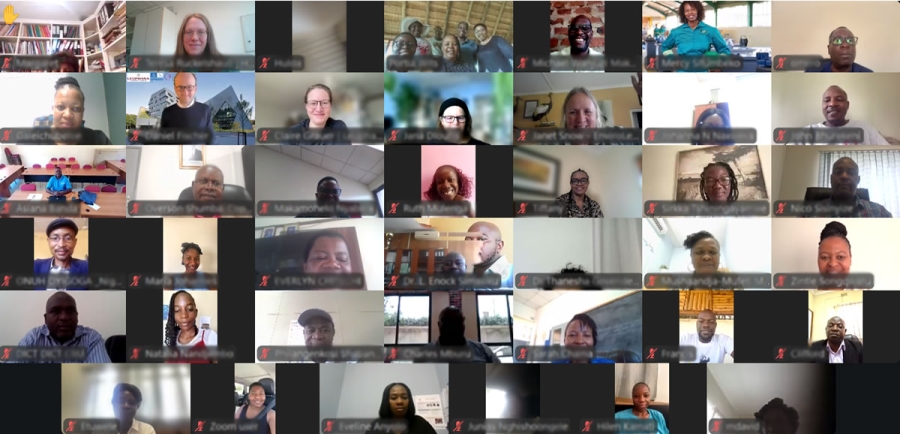
The teams of University of Namibia and Heidelberg University of Education supported by Rhodes University in South Africa successfully launched the "Sustainability Starts with Teacher Leaders" course through a workshop held online on Thursday, 27 November 2025. The launch event was the first workshop of the course to onboard the participants with five action learning cycles for teacher educators and further information about logistics of the course. The session was attended by over 80 participants.
Manoah Muchanga, Associate Professor at University of Zambia, presented key findings from the survey on the Unit-based Sustainability Assessment Tool (USAT) administered to over 1,500 participants including teacher leaders, students, policy makers and administrators in Kenya, Malawi, Namibia, South Africa and Zambia. In this session, the participants learned how to analyze USAT results demonstrating the need to align Teacher Professional Standards with Education for Sustainable Development (ESD) policies in Sub-Saharan Africa. Zintle Songqwaru, senior lecturer at Rhodes University, presented a policy analysis which covered four regional, twenty-four national (Kenya, Malawi, Namibia, South Africa and Zambia) and one institutional policy documents on ESD and teacher training. The analysis indicated surveyed countries do not explicitly reference ESD in their teacher professional standards, however, ESD-aligned values, including sustainability and professional development, are often embedded implicitly. Multi-stakeholder engagement emerged as a common strategy for ESD implementation, although policy coherence and integration vary on the ground.
The project "Sub-Saharan Africa Teacher Leadership for Education for Sustainable Development", is co-funded by the European Union under Capacity Building in Higher Education Strand. The project aims to build a cadre of trained ESD teacher leaders to address the "teacher gap" to deal with sustainable development challenges in Africa which is poised to be home to half of the world’s children by 2050. The "teacher gap" is defined as a shortfall in quantity of teachers and quality of teachers’ competences. The SSATL-ESD project seeks to address this gap through accelerating innovation in the field of ESD Leadership in teacher education, including leveraging digital transformation to advance teachers’ competences for green economies and sustainable societies.
In case you are interested, non-participant institutions can join the thriving Communities of Practice on ESD Teacher leadership set up by Rhodes University by joining the virtual community on Whatsapp by clicking here or write to the email address
► Please refer to the project website https://lead4esd.net/ for latest updates on the project.
This article has been co-authored by Teresa Ruckelshauß at Heidelberg University of Education.
For any further information, contact:
Deepika Joon
Project Coordinator
Leuphana University Lüneburg
Universitätsallee 1, 21335 Lüneburg. Germany