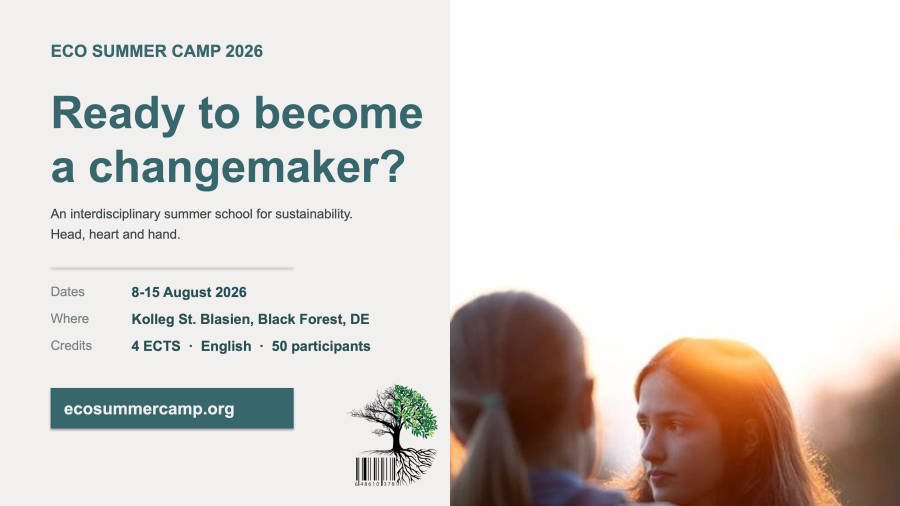
From 8-15 August 2026, the Eco Summer Camp brings 50 students, young professionals and lifelong learners from over 20 countries to Kolleg St. Blasien in the Black Forest for a week of interdisciplinary learning on sustainability. The programme integrates head, heart and hand, offers 4 ECTS through the Newman Institute Uppsala, and is held in English.
Eco Summer Camp 2026 — From Wild Consumption to Responsible Engagement
How do we move from knowing about the sustainability crisis to acting within it? After four editions in Switzerland, the Eco Summer Camp (ESC) opens a new chapter from 8 to 15 August 2026 at Kolleg St. Blasien in the Southern Black Forest Nature Park, Germany. ESC is a one-week interdisciplinary, intergenerational summer school that brings together around 50 participants from more than 20 nations. Roughly 80 percent are students and young professionals between 18 and 35; the remaining 20 percent are lifelong learners who join the conversation as peers. The working language is English, and participants can earn 4 ECTS through our academic partner, the Newman Institute Uppsala.
A holistic pedagogy: head, heart and hand
ESC combines three dimensions of learning that are rarely integrated in academic settings:
- Head — expert lectures and interactive seminars on systemic sustainability questions
- Hand — workshops, field trips and practical contributions to daily camp life
- Heart — guided reflection, eco-spirituality and meditation as a basis for inner resilience
All participants and faculty stay together on campus for the full week, which fosters the kind of informal exchange and personal encounter that a typical conference cannot offer.
The 2026 research question
The week is organised around one guiding question: Where do we want to go as a society by 2050, and what does it take from each of us to actively shape that path? We explore this through three thematic strands: inner strength and meaningful work; technology within planetary boundaries; and peace and participation.
Venue
Kolleg St. Blasien sits on the grounds of a former Baroque monastery in the Southern Black Forest. Workshops take place in the new NaWi-Zentrum, a natural science campus built in regenerative timber construction.
Network and partners
ESC is hosted by Kolleg St. Blasien e.V. in partnership with the Newman Institute Uppsala, oikos international, the Ukama Center, LIONE, and the Jesuit European Social Centre. Since 2021, more than 180 alumni from 21 countries have shaped the ESC community.
Participation fees start at € 500 for students sharing a double room, and reduced fees are available for those who need them so that cost is not a barrier.
An invitation to COPERNICUS Alliance members
We would be grateful if COPERNICUS Alliance member universities helped us reach students and early-career researchers who would benefit from this experience. Concretely, you can:
- Forward this announcement through faculty and student mailing lists
- Share it via your sustainability office, career service or international office
- Post it on departmental notice boards or social channels
- Recommend ESC to PhD candidates, master's students or staff working on sustainability
Contact: Michael Yang,
► More information and registration